From SMART to SMARTIE Goals?
A now a little something from your friendly data guru.
At this point, SMART goals have taken over the business and measurement worlds. The good news is that even if you don't know what SMART goals are or how to set them, you're probably already doing them. If we haven't seen this graphic, we've seen one like it probably countless times before. My guess is your strategic plan is FULL of of these kinds of goals.


For example, the Building Movement Project, a non-profit consulting firm devoted to helping organizations become more equitable and fostering social change through movement building, found that people of color in the nonprofit sector often encounter structural barriers that make it more difficult to reach leadership roles. SMARTIE goals could directly address the structural barriers by specifying the aim to change the barrier and see that change directly in the people who have been caught up by that barrier.
At this point, SMART goals have taken over the business and measurement worlds. The good news is that even if you don't know what SMART goals are or how to set them, you're probably already doing them. If we haven't seen this graphic, we've seen one like it probably countless times before. My guess is your strategic plan is FULL of of these kinds of goals.
See anything missing?
If we're ever going to move our practices, our system, from exclusive to inclusive, maybe it's not just having the goal of equity but also the PROCESS of building equity and inclusion. It seems as "simple" as transitioning our SMART goals to SMARTIE goals--that is, adding EQUITY and INCLUSION into the goal making process itself.
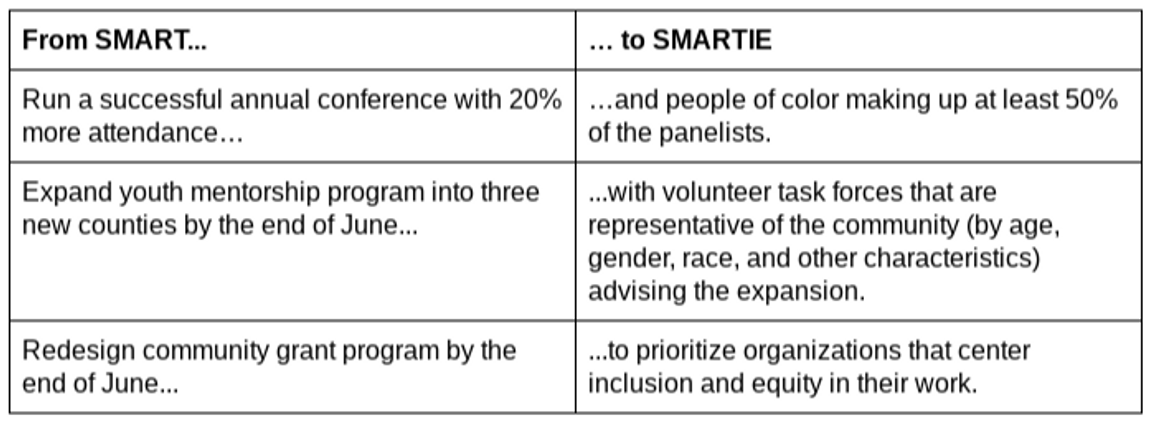
Here's what the difference looks like:
Here's some other ideas:
For example, the Building Movement Project, a non-profit consulting firm devoted to helping organizations become more equitable and fostering social change through movement building, found that people of color in the nonprofit sector often encounter structural barriers that make it more difficult to reach leadership roles. SMARTIE goals could directly address the structural barriers by specifying the aim to change the barrier and see that change directly in the people who have been caught up by that barrier.
The examples above show how being specific about the outcome--calling out the inclusion and equity elements as part of the outcome--can change everything about the strategic approach to addressing the actual (and not just perceived) barriers.
EC2C will be working to apply these principles to our own collective strategic goals. Can we count on our partners to work alongside us?

Comments
Post a Comment